
Roger Küng
Head of Operations EnergyCuringRAHN AG

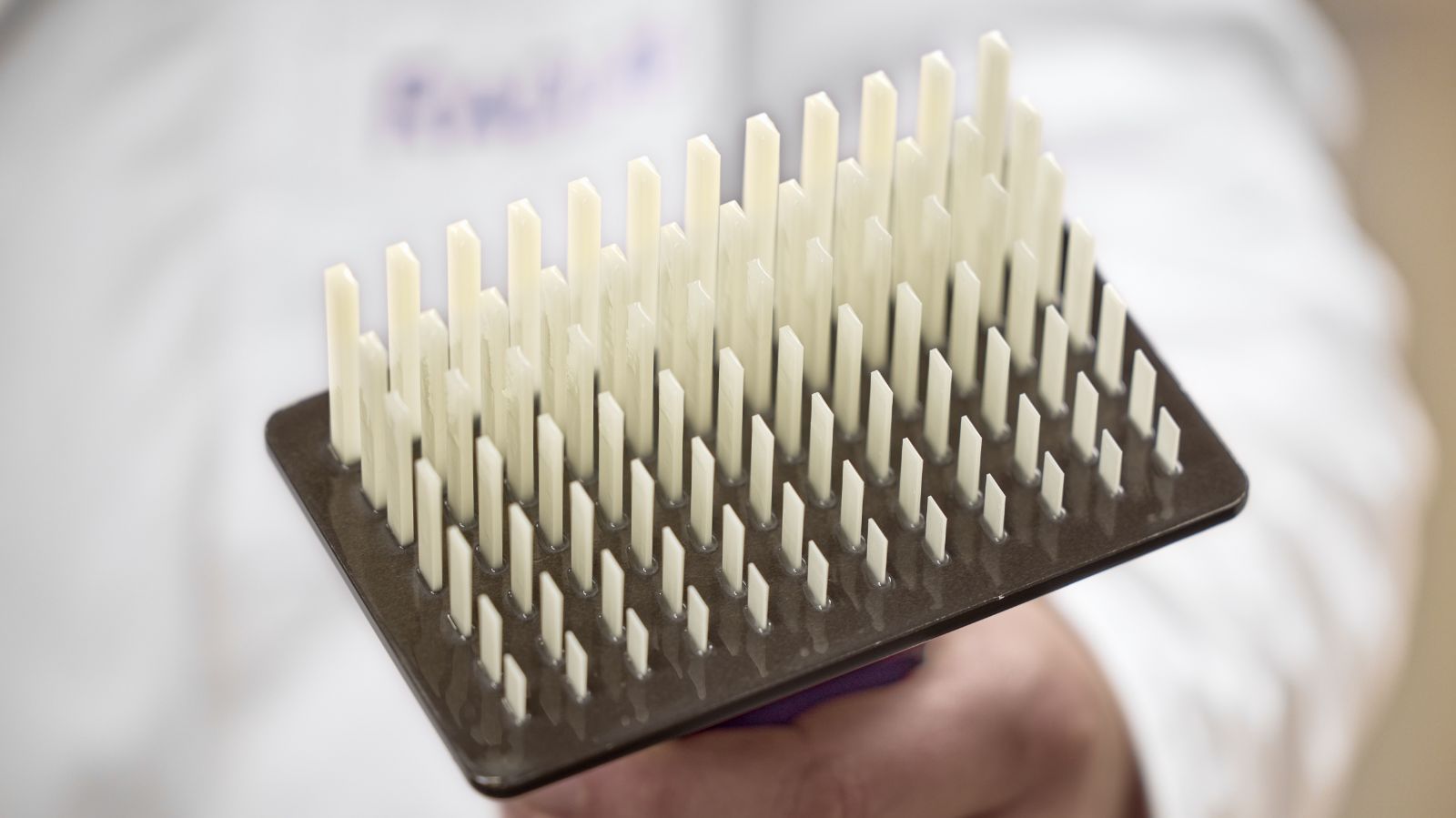
DLP 3D printing (digital light processing 3D printing) is a UV additive manufacturing technique that cures entire layers of photopolymer resins and is used where speed of production is critical. DLP 3D printing offers detailed, intricate models that are used for a wide variety of applications, including prototypes, 3D printed jewellery, dentistry or medical devices.
The following article gives you a thorough overview of the innovative printing technique, its possibilities and what kind of photopolymer resins are needed to create the desired results.
DLP 3D printing (digital light processing 3D printing), along with others like material jetting, SLA printing, etc. is an additive manufacturing technique that uses light and photopolymers to create three-dimensional objects layer by layer.
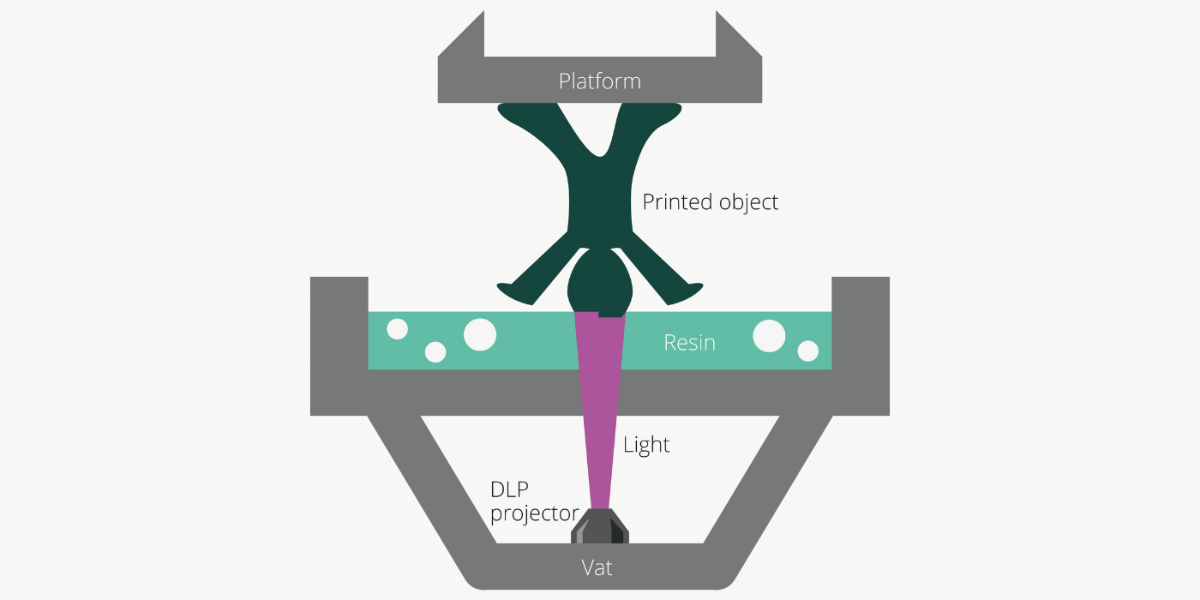
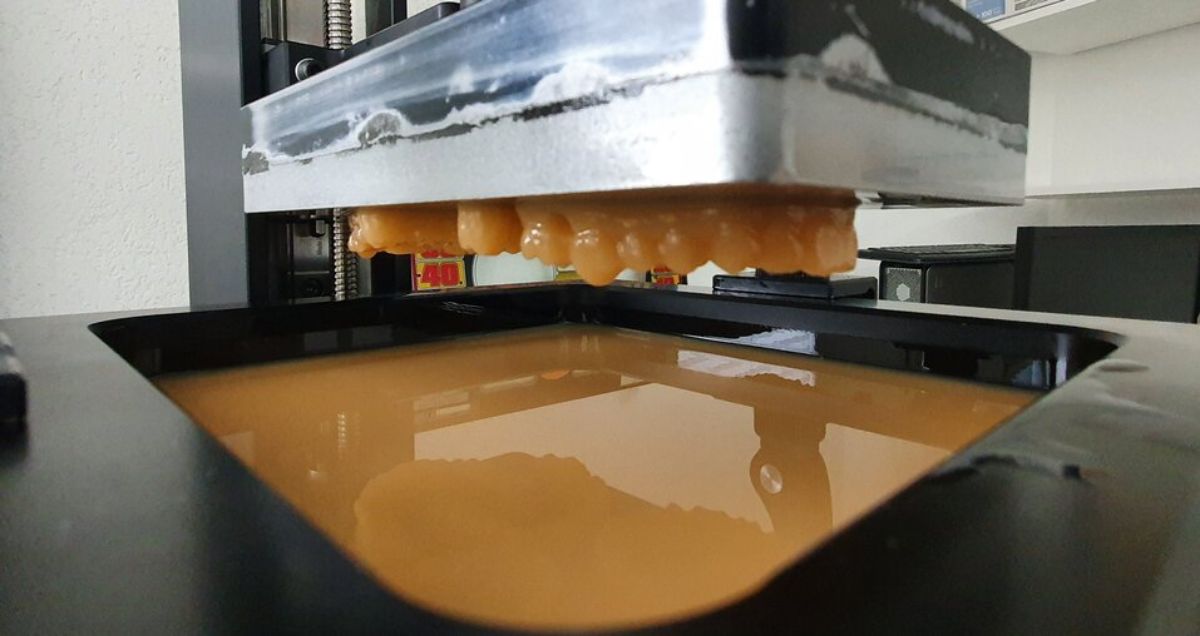
The printing process uses a liquid photopolymer resin that hardens when exposed to light. A build platform is submerged or positioned just above a vat of the liquid photopolymer resin. The digital light projector shines UV light onto the resin, and the projected image corresponds to the first layer of the 3D object.
The areas of the photopolymer resin that are exposed to the UV light start to solidify or cure, while the uncured resin remains liquid.
The build platform is then incrementally lowered, allowing a new layer of liquid resin to flow over the cured layer. UV light is projected again to cure the new layer onto the previous one. This process of layer-by-layer curing and platform movement is repeated until the entire object is built.
Once the printing is complete, the object is typically still surrounded by uncured resin. It needs to be carefully removed from the build platform and to undergo post-processing steps, which may include rinsing, further curing under UV light as well as sanding, polishing or painting, depending on the desired finish.
Compared to some other resin-based processes, DLP 3D printing offers advantages like faster print times, thanks to the simultaneous curing of each layer. At the same time, the level of detail and surface finish is still very high, making it suitable for applications that demand intricate and detailed objects.
DLP printers often come with user-friendly software interfaces, making them relatively easy to set up and operate.
The slicing software used for DLP printing allows for quick adjustment of parameters like layer height and exposure time. Some DLP printers offer relatively large build volumes, which enables the creation of larger objects in a single print. This can be advantageous for prototyping or producing larger parts.
DLP 3D printing enables the creation of highly customised objects, which is suitable for the production of highly-customizable one-off or low-volume production items.
DLP 3D printing is commonly used in industries such as jewellery, dentistry and medical devices, where precise and detailed prototypes are crucial for testing and validation. Similarly, digital light processing 3D printing plays a crucial role in the healthcare industry. While DLP excels in high-precision applications, other 3D printing technologies, like 3D printing in construction, enable large-scale manufacturing for architectural and infrastructure projects.
DLP 3D printing in healthcare is used, for instance, where precise dental models of patients' teeth and gums for treatment planning, orthodontic appliances, crowns, bridges and other dental applications are needed. On top of that, hearing aids and even anatomical models for medical education and surgical planning can be created with DLP 3D printing due to its high accuracy and resolution.
Applications in Dentistry
Applications in Medical Devices
DLP 3D printing is revolutionizing jewelry design by allowing high-resolution, intricate detailing that was previously impossible with traditional handcrafting techniques. Designers can create complex patterns, filigree work, and organic shapes with unparalleled precision, significantly reducing the time and cost associated with mold-making.
Key Advantages for Jewelry Designers:
Digital light processing 3D printing has become a cornerstone technology in engineering and manufacturing, offering a rapid, cost-effective alternative to traditional prototyping methods. Its capability to quickly iterate designs and deliver highly accurate functional prototypes makes it an essential tool for aerospace, industrial production, and 3D printing for automotive parts.
Common applications are:
DLP 3D printing is paving the way for major advancements in medical research, tissue engineering, and bioprinting. Its ability to reproduce highly detailed anatomical structures makes it an invaluable tool for surgical planning, medical training, and the development of biocompatible implants.
Innovations in Bioprinting and Medical Research:
DLP printers can work with a wide range of photopolymer resins, each tailored to specific applications. This includes resins with various mechanical properties, colours as well as transparency levels.
The resin requirements for digital light processing 3D printing can be summarised as follows:
Even though DLP 3D printing has a lot of similarities with SLA (Stereolithography) 3D printing, there are still major differences between the processes, which result in different applications that serve different requirements.
DLP 3D printing uses a digital light projector to project an entire layer of the object onto the surface of a vat, solidifying the liquid photopolymer resin according to the shape of the object. As each layer is cured, the build platform gradually moves upward, distancing the solidified layers from the resin vat.
On the other hand, SLA 3D printing employs a laser beam that moves across the surface of a vat filled with liquid photopolymer resin. For even finer precision and detailed microstructures, microstereolithography (MSL) offers enhanced capabilities.
The laser selectively cures specific points in the liquid resin, causing it to solidify at those points. As each layer is scanned and cured, the build platform also gradually moves upward to create the object layer by layer.
As a result of these processes, DLP printing is usually faster due to its ability to cure entire layers at once, whereas SLA cures point by point with a laser, making it generally slower. SLA prints often have a smoother surface finish, while DLP prints can be slightly more textured.
Some 3D printing resins formulated for SLA might not work optimally in DLP printers and vice versa, so it's important to choose the appropriate resin for your printer.
Comparison Table: Digital light processing 3D printing vs SLA
| Feature | DLP 3D Printing | SLA 3D Printing |
| Speed | Faster (cures layers at once) | Slower (cures point-by-point) |
| Resolution | High, but slight pixelation | Ultra-smooth detail |
| Material Cost | Depends on the resin used | Depends on the resin used |
| Ideal Applications | Prototyping, dental, jewelry, engineering-grade prototypes | Prototyping, dental, jewelry, engineering-grade prototypes |
While digital light processing 3D printing offers major advantages, such as high speed, accuracy, and smooth surface quality, it also comes with certain limitations. Understanding these potential drawbacks helps determine when DLP is the right manufacturing technology for your specific needs.
Key disadvantages of DLP 3D printing include:
Additional considerations include:
Despite these disadvantages, DLP 3D printing remains one of the fastest and most precise resin-based manufacturing methods available today.
DLP 3D printing provides higher precision than FDM, making it ideal for intricate designs but at a higher material cost due to resin usage. Compared to Material Jetting, DLP is more affordable but lacks full-color and multi-material capabilities, though options like different 3D printing resin colors can expand its applications, making it best for functional, high-detail parts rather than aesthetic models.
DLP 3D printing already delivers high-quality, repeatable, functional parts and the technology continues to advance rapidly. Key developments shaping the future of digital light processing 3D printing include:
These innovations will make DLP 3D printing even more scalable, efficient, and suitable for production-grade manufacturing.
Digital light processing 3D printing parts can be highly durable depending on the resin formulation. Engineering-grade resins provide high-impact resistance and mechanical strength, making them suitable for functional prototypes and industrial applications. However, all photopolymer resin 3D prints will require post-curing.
While digital light processing 3D printing offers high precision and speed, it has some limitations:
DLP 3D printing materials must meet the following requirements:
DLP parts can be highly durable when printed with the right resin. Tough, engineering, and elastomeric resins can withstand mechanical stress, impact, and repeated flexing. However, all DLP prints require proper post-curing to reach their full strength.
DLP 3D printing is one of the fastest and at the same time a highly precise printing method to achieve great results and fast turnaround times.
We are experts in the field of photopolymers and our labs are equipped with industry-level SLA, DLP and LCD 3D printers, which enables us to develop custom solutions of raw materials for 3D printing that perfectly fit your needs.
Get in touch and book a call with our experts to find the best solution for your project.
Access our latest 3D printing lab report now.
RAHN AG